
Research

Publications

Representations, priors, and reliable reconstruction.
A closer look at the questions behind my first-author papers.

ECCV2026

3D Field of Junctions: A Noise-Robust, Training-Free Structural Prior for Volumetric Inverse Problems

Namhoon Kim*, Narges Moeini*, Justin Romberg, Sara Fridovich-Keil

* Equal contribution; author order determined by coin flip.

Recovering 3D structure without training data.

We represent a volume as overlapping junctions of 3D wedges, fitting local geometry while encouraging consistency across patches. This training-free prior preserves sharp boundaries in noisy low-dose CT, cryo-electron tomography, and point clouds, and can be used within iterative reconstruction algorithms.
NeurIPS2025

Grids Often Outperform Implicit Neural Representation at Compressing Dense Signals

Namhoon Kim, Sara Fridovich-Keil

When is a neural representation the right choice?

We compare neural, hybrid, and grid representations across 2D and 3D signals at matched parameter budgets. Regularized interpolated grids often fit dense signals faster and more accurately, while neural representations can be advantageous for lower-dimensional structure such as shape contours. The benchmark connects these differences to signal bandwidth, model capacity, and inverse tasks.

IEEE CAMSAP · Invited paper2025

Towards Distribution-Shift Uncertainty Estimation for Inverse Problems with Generative Priors

Namhoon Kim, Sara Fridovich-Keil

Recognizing when a learned prior may be unreliable.

A learned prior can produce a convincing reconstruction even when the target differs from its training data. We use variation across reconstructions from randomized measurements as an instance-level indicator of distribution shift. Experiments on tomographic reconstruction of MNIST digits show increased instability for out-of-distribution targets, without calibration data or retraining.

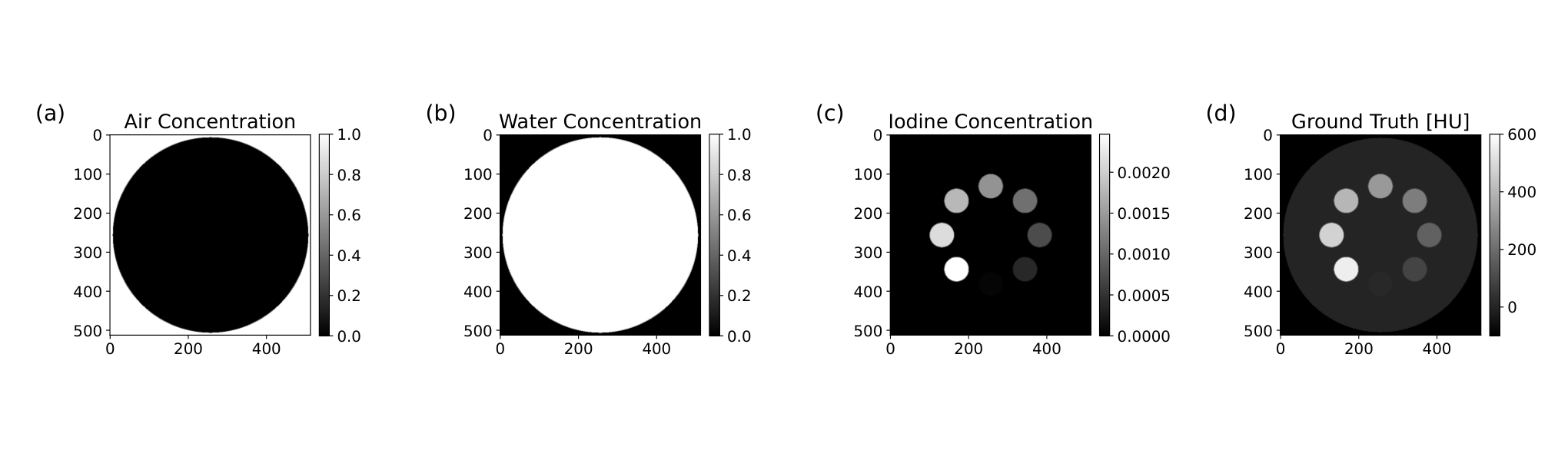
Ground-truth air, water, and iodine material maps and CT image of the digital perfusion phantom.
04Physics-based imaging

Preprint2026

Perfusion Imaging and Single Material Reconstruction in Polychromatic Photon Counting CT

Namhoon Kim, Ashwin Pananjady, Amir Pourmorteza, Sara Fridovich-Keil

Reconstructing contrast-agent concentration with fewer photons.

We adapt a variational-inequality reconstruction method to polychromatic photon-counting perfusion CT, estimating iodine concentration with a known static background. Digital-phantom experiments investigate how to distribute a limited photon budget across projection views and demonstrate improved reconstruction over filtered back-projection in low-dose settings.